

If you are planning to buy a new gaming laptop this year, then you are in luck. All major chipset makers including Intel, AMD and Nvidia are bringing new silicon for gaming notebooks across segments. We are also looking at adopting faster DDR5 memory, PCIe Gen 5 SSDs and larger screen options. Here’s an in-depth look at what you can expect from gaming laptops in 2023.
intel cpu
With its fierce focus on gaming, it’s no surprise that there are more gaming laptops with Intel processors than AMD on the market. In fact, a large number of consumers prefer Team Blue to Team Red.
The company’s latest offering for notebooks, the 13th generation ‘Raptor Lake’ mobile series, has already started shipping on select devices. The range is divided into the usual HX, H, P and U series classifications. Specifically for gamers, Intel is bringing more SKUs under its flagship HX series than the previous generation. Leading the pack is the Core i9-13980HX which is now Intel’s fastest mobile processor with a clock speed of 5.6GHz. It also comes with a total of 24 cores (8P+16E) and 32 threads, the same as the Core i9-13950HX and Core i9-13900HX. The HX-series has a TDP range of 55W to 157W, support for DDR4-3200 and DDR5-5600 memory, as well as PCIe 5.0 x16 support that could potentially be split into 2×8.

The H-Series Raptor Lake mobile processor remains the traditional choice for gaming laptops. There are a total of eleven new H-series SKUs with the Core i9 series topping out at 14 cores (6p+8e) and up to 20 threads. Base TDP of 45W with the Core i9 and Core i7 going up to 115W and the Core i5 going up to 95W. The H-Series comes with four Thunderbolt 4 connectors and support for up to DDR5-5200/LPDDR5-6400, or DDR4-3200 memory.

The current crop of 12th-gen Alder Lake Mobile processors is pretty impressive and was a generous upgrade over the 11th-gen. It is expected that 12th generation Intel gaming laptops will see a small price cut after the new 13th generation laptops take over, so they are definitely worth considering if you have a tight budget. In terms of core count, the outgoing 12th-gen HX-series packs 16 cores, 24 threads, and clock speeds of up to 5GHz on the Core i9-12950HX and 12900HX. They also come with the same base and boost TDPs of 55W and 157W respectively, just like the Raptor Lake. Even the H-series is worth the money, especially the Core i9 and Core i7 models with 14-cores and 20-threads (except for the Core i5-12650H).
amd cpu
AMD launched its new Ryzen 7000 mobile processor at CES 2023. Aside from the obvious advanced technology, the naming scheme for the new series has been changed and can be confusing. To clarify, here is a table that explains what each number represents.
Basically you need to remember that the first digit represents the year in this case ‘7’ which is 2023, the second digit is the segment (Ryzen 9, Ryzen 7, Ryzen 5, Ryzen 3), the third digit for CPU architecture (Zen 4, Zen 3, Zen 2, etc.) while the fourth will be either 0 (lower segment) or 5 (higher segment). The U, HS and HX suffixes continue to define TDPs, and AMD has phased out the H-series this year. In short, expect AMD gaming laptops to use HX and HS processors as they come with 55W+ and 35W/45W TDPs respectively.


Ryzen 7045 series is the most powerful and power hungry. It is based on the TSMC 5nm node that AMD is using for the Ryzen 7000 desktop line-up. The Ryzen 9 7945HX sits at the top with 16 total cores, 32 threads, a boost frequency of 5.7 GHz, a configurable TDP of 55-75W+, and 64 MB of L3 cache. There’s also the Ryzen 9 7845HX, which is a 12-core/24-thread CPU, the Ryzen 7 7745HX with 8-core/16-threads, and the six-core AMD Ryzen 5 7645HX. The Ryzen 7045HX series will first be available on the ASUS ROG Strix, Lenovo Legion and Alienware m16 and m18 range of laptops.

Next in line is the Ryzen 7040 which is considered to be the truly new chipset among AMD’s Ryzen 7000 mobile range. It is the company’s first Zen 4 mobile CPU built on TSMC’s 4nm process with new CPU cores, new RDNA 3 iGPUs and a dedicated AI engine to improve efficiency. AMD will initially launch 3 SKUs under the Ryzen 7040 Mobile series with TDPs of 35W to 45W. The Ryzen 9 7940HS and Ryzen 7 7840HS have 8-CPU cores and differ only in terms of clock speeds. The Ryzen 5 7640HS will have a total of 6 CPU cores. Notably, the 7040 series supports DDR5-5600 and LPDDR5x-7500 memory, but since the HX series is meant for peak performance, it will be interesting to see if laptop makers actually offer higher speed memory on the 7040 series .
There’s also the Ryzen 7035 series, and while they include some HS models, there’s no clarity on whether we’re going to see these chips on gaming laptops. As for the outgoing Ryzen 5000 and 6000-based gaming laptops, they’re still quite viable, especially if you’re looking for a powerful mid-range gaming machine with good battery life.
nvidia gpu
As a follow-up to the GeForce RTX 40-series desktop GPUs, Nvidia introduced the RTX 40-series GPUs for laptops at CES 2023. The new lineup of discrete GPUs will be available on a variety of gaming laptops from major brands like Alienware, ASUS, Gigabyte, Lenovo, MSI, and more.
At the time of writing this, the RTX 4090 and 4080 laptops are already available for purchase, while the mid-range RTX 4070, 4060 and 4050 will be available in the coming days. Like the previous RTX 30 series mobile GPUs, the new range will come with a configurable TDP. This means that laptop manufacturers will have the freedom to set a certain power draw limit and frequency for the GPU. OEMs are also expected to indicate GPU wattage and clock frequency in their product specifications, giving consumers an idea of what kind of performance they can expect.

The new RTX 40-series mobile GPUs are said to be more efficient and can compete with the last-gen RTX 30-series with only one-third the power. While that’s a bold claim, gaming is possible using Nvidia’s new DLSS 3, better known as DLSS frame generation. So while this statement is true, you might not see a huge performance gain in every game. It also needs to be remembered that not every RTX 40-series mobile GPU is equal to its desktop counterpart. For example, the RTX 4090 Mobile offers a total of 9728 CUDA cores compared to 16384 on the desktop version, which is a huge difference. Rather, the RTX 4090 mobile is in line with the RTX 4080 desktop version in terms of CUDA cores, memory size, and memory interface. The only difference is that the laptop version of the RTX 4090 can only be configured with a lower TDP and uses 16GB of GDDR6 instead of 16GB of GDDR6X memory. Another significant change is that the lowest-end GPU in the segment, the RTX 4050, comes with 6GB of memory which is a nice upgrade from last year’s standard 4GB on the RTX 3050.
The new ADA architecture also brings high-efficiency on-chip memory that helps reduce GPU power consumption with twice the bandwidth, more than 10 times the capacity, and improved clock gating. There’s also new tri-speed memory control that enables the GPU to dynamically switch to new, lower-power memory states, further improving power efficiency when the system is idle or using low-intensity apps Is. Finally, ultra-low voltage GDDR6 memory helps increase GPU efficiency through the integration of the lowest voltage graphics memory ever.
The new RTX 40-series for laptops also brings new AV1 encoders to improve livestream video encoding by enabling 4K60 at 10Mbps streams, which is more efficient than H.264 which takes 20-25Mbps for quality 4K streams uses. For editing video the new NVENC Dual AV1 encoder (only available on the GeForce RTX 4080 and 4090) can be used in parallel to export video up to 2x faster.
amd gpu
In addition to its new line of mobile CPUs, AMD is also upgrading its mobile GPUs. The new Radeon RX 7000M and 7000S are based on AMD’s RDNA 3 6nm architecture and feature dedicated AI and second-generation ray-tracing accelerators. They also come with AV1 encoding acceleration support, AMD FidelityFX Super Resolution Technology (FSR) 2.2, and AMD Radiance Display Engine with 12-bit-per-channel color and high refresh rate display support.

There are two 7000M GPUs which are more high-end and are said to deliver a ‘desktop-class experience’. The Radeon RX 7600M XT offers 32 compute units, 8GB of GDDR6 memory running on a 128-bit interface, 32MB of Infinity Cache, and a clock speed of 2,300MHz. The RX 7600M, on the other hand, has 28 compute cores and a frequency of 2,070 MHz, with all other specifications identical to the XT variant. The RX 7000S series will be available on laptops running between 50-100W, so expect a drop in performance compared to the 7000M chips. The Radeon RX 7700S offers the same specs as the 7600M XT, but a lower frequency of 2,200MHz. The RX 7600S includes 28 compute units and runs at up to 1,865MHz.
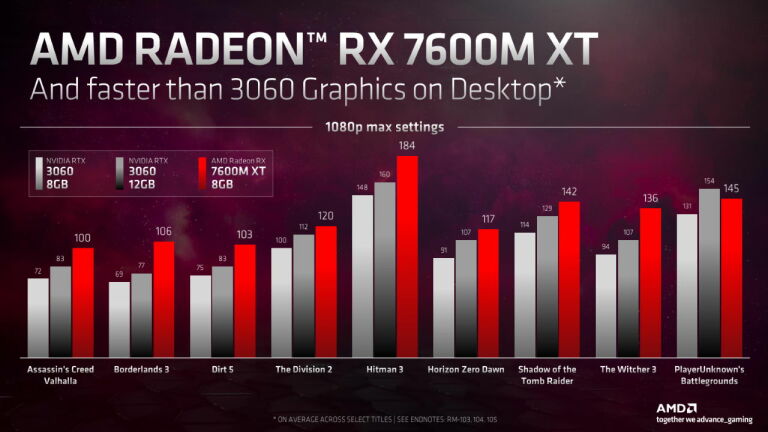
According to AMD, the 7000M GPUs will offer up to 26 percent higher performance on average, while the 7000S GPUs will deliver up to 29 percent higher performance on average compared to previous-generation AMD Radeon GPUs in gaming titles at 1080p resolution. These new GPUs will also use AMD SmartShift RSR technology, which is said to intelligently distribute rendering, upscaling and presentation demands between APU and GPU resources to help deliver the best possible performance.
Although AMD is bringing better ray tracing support and FidelityFX super resolution upscaling, Nvidia has a firm hold on both these technologies.
DDR5 memory
DDR4 was long gone but now we have DDR5 memory. The new standard not only comes with faster clock speeds, but also includes some much-needed improvements and upgrades. It consumes 20 percent less power than DDR4 and features an onboard PMIC or power management integrated circuit. This helps control power to the various components on the memory module. It also features improved ECC (error correction code), increased bank and burst lengths, and dual 32-bit sub-channels.

In a separate article I mentioned how DDR5 memory isn’t going to massively improve gaming performance. But considering that DDR5 memory isn’t as expensive as it was at launch, buying a gaming laptop with DDR5 memory makes a lot of sense. Besides, why would you want to stick with the old generation memory standard for a few more years?
PCIe Gen 5 Storage
Modern gaming laptops feature M.2 storage with support for PCIe Gen 4 or at least Gen 3. We saw a few models last year, like the MSI GT77 Titan 12UHS, that offered support for even faster PCIe Gen 5 SSDs. While most gaming laptops in 2023 are expected to offer PCIe Gen 4 storage (at least the first half of 2023), which is totally fine, Gen 5 ensures transfer speeds of 10,000MBps and above, which is insane. Is. In short, you’re fine with either, but if you really want better performance and a future-proof laptop, make sure you get a laptop that offers support for PCIe Gen 5 drives.
new display size

A few years ago we saw a new breed of 14-inch gaming laptops. While the category is still gaining momentum, be prepared for more unorthodox screen sizes. Alienware, ASUS, Acer, Lenovo and Razer are preparing to launch new 16-inch and 18-inch gaming laptops in 2023 that go beyond the traditional screen sizes we’re used to. Of course, this means you’ll get a bigger screen real estate to play with and some of these new laptops will come with 16:10 aspect ratios giving you more vertical screen space.


