


We often prioritize the GPU and CPU over other hardware components when searching for a new gaming laptop. However, with the advent of the DDR5 standard, memory or RAM is equally important and even more so. DDR4 memory has been around for a long time, around eight years now and remains efficient with excellent stability. In fact, you can still get a new mid-range or lower-end laptop that uses DDR4 memory. However, with the leap to DDR5, faster clock speeds can be expected, leading to improved performance across a wide variety of operations and tasks.

It is nearly impossible to compare and show you a one on one performance difference, as there is no laptop manufacturer that offers the same laptop with DDR4 and DDR5 memory options. However, we can tell you about everything else.
key design
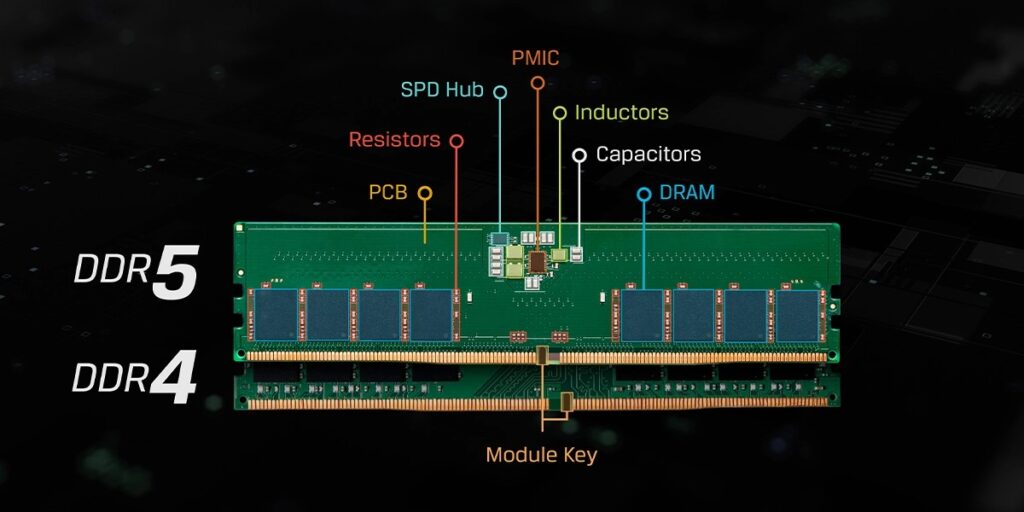
Physical Design DDR5 memory modules for laptops have the same size and shape as DDR4. But the gap between the key or contact pin has been removed. This means that one cannot install DDR4 memory on a DDR5 slot and vice versa.
low power consumption
DDR5 memory consumes 1.1V of power which is about 20 percent less than DDR4 which typically consumes 1.2V. While this may not make much of a difference, it can help improve the battery life of the laptop.
PMIC
DDR5 memory comes with an onboard PMIC or Power Management Integrated Circuit that helps in regulating power to the various components present on the module. PC-class modules take the total 5V of power and convert it to the 1.1V needed by the various chips on the memory module. In addition to better power delivery, this change was important because it helped with signal integrity, allowing DDR5 to be up to 50 percent faster than the previous generation.
faster clock speed
The fastest DDR4 memory you can get for a gaming laptop is DDR4-3200, which is basically memory clocked at 3200MHz or 3200MT/s. Then there’s also low-profile DDR4 or LPDDR4/LPDDR4x memory that goes up to 4266MHz, usually for slim and ultraportable laptops, where the memory is soldered onto the motherboard and can’t be removed or upgraded by the end user. Could With DDR5, we’re already seeing DDR5-4800 available on many gaming laptops, with DDR5-6000 and faster modules expected to arrive this year.
dual 32-bit sub-channels
Unlike DDR4, DDR5 divides the memory module into two 32-bit addressable sub-channels. This is done to increase efficiency and reduce data access latency for the memory controller. Breaking the module into two 32-bit addressable channels helps increase overall performance.
Better ECC
DDR5 memory also brings improvements with ECC (Error Correction Code). Increasing the density of DRAM chips through shrinking wafer lithography increases the risk of data leakage. Having on-die ECC DDR5 memory reduces risk by correcting errors within the chip making it more reliable and with a lower fault rate.
increased banks and burst length
A significant upgrade introduced with DDR5 is an increase in data banks from 16 to 32, as well as an increase in the minimum burst length from 8 to 16 for DDR4. In addition to providing better data bus efficiency, the bus carries twice as much data which reduces the number of read and write processes required to access the same cache data line. DDR5 also introduces a new command called Same-Bank Refresh where it can refresh just one bank per bank group as opposed to all banks. This helps in further enhancing the performance and efficiency.
There have been some early concerns about DDR5 memory, however. The more complex design of RAM modules means higher production costs. DDR5 memory was quite expensive when it launched last year, and while the price has come down, it remains more expensive than DDR4. The other problem with DDR5 is timing. CAS latency is significantly higher on DDR5 than DDR4. It is expected that faster frequencies, higher bandwidth, better ECC (error correcting codes), and increased numbers of ICs will solve this. Finally, since the PMIC is embedded on the memory module itself, it is expected to run hot which means proper thermal solutions may be required.
What does this mean for gaming?
From the various announcements made at CES 2023, it is clear that DDR5 memory for laptops is already gaining momentum. Almost every gaming laptop launching in 2023 is expected to come with DDR5 memory with faster frequencies than ever before. In fact, ASUS has announced the new ROG Flow X13 and Flow Z13 that are going to feature LPDDR5 clocked at up to 6200MHz.

Theoretically, DDR5 memory is going to have a smaller impact on games, especially titles that rely on more memory. Where it excels is in real world applications. Whether it is compression or decompression, encryption, kernel compilation, video rendering, etc. DDR5 is definitely faster than DDR4. The difference between DDR4-3200 kit vs DDR5-4800 kit is not huge, but significant in most cases.
We are yet to fully test DDR5-equipped gaming laptops to see if they offer a better gaming experience than DDR4. However, from the various tests we’ve seen online, we can tell you that some gaming titles have experienced increases of up to 7-10 percent and overall average around 2-3 percent. While this may not sound very significant, the bigger picture is that gaming notebooks in 2023 will get updated CPUs from Intel and AMD, as well as new RTX 40-series mobile GPUs from Nvidia. These in themselves are going to have a huge impact on gaming performance, along with overall improvements in visuals and framerates.
Regarding pricing, there will be a relative increase if you plan to get a higher-capacity kit directly from the laptop manufacturer. Essentially upgrading a DDR5 gaming laptop from 16GB to 32GB of RAM can cost you around 20-30 percent more money than a DDR4 gaming laptop. This, as I mentioned, is due to the more complex design of DDR5 memory modules. However, it is expected that the price difference should soon narrow down as we have more DDR5-equipped notebooks in the market.


