


Looking for a compact smartphone? You may find that your options have become very limited. Initially the shift towards bigger screen phones was subtle but now they are the overwhelming majority of the market. Consumers demand good battery life on their handsets and it’s easier to push a higher capacity cell when screen real estate is more. Except for Apple’s iPhone lineup, the Android world hasn’t really perfected the formula for a compact design with a lasting battery.

Samsung’s Galaxy S23 (Review), launched earlier this month, may change that perception. Our review of the device clearly rated the S23 as “The best small Android phone on the market right now”. I spent a full day with the Galaxy S23 as my primary device and here’s what I found about its battery life.
Battery Capacity and Usage
The Galaxy S23 packs a 3,900mAh battery on the inside, which is a smaller capacity cell than the standard 5,000mAh we usually see in smartphones these days. Last year’s Galaxy S22 had abysmal battery life, with the handset barely getting past a day of moderate use. Samsung has certainly made efforts to rectify that particular shortcoming with the Galaxy S23. Qualcomm’s Snapdragon Gen 2 SoC running under the hood has also worked in favor of the device in terms of power efficiency.
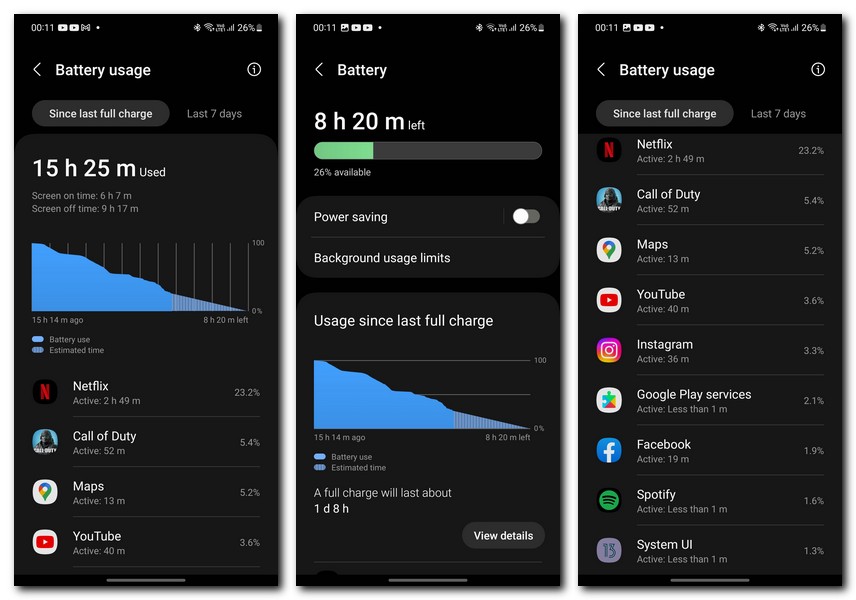
Above I have shared some screenshots which made my day with S23. I should note that this could be considered particularly heavy use since I used about three hours of Netflix and about an hour of Call of Duty: Mobile. It also included one hour of navigation, although it was mostly working in the background. Also a significant amount of time was spent watching YouTube and browsing through my Instagram feed. I should also point out that most of my Netflix time was on 5G and not Wi-Fi.
Keeping all these things in mind, I started my day by fully charging the S23 at around 9 am. My screen was at full brightness for the most part as I was watching content on the go in bright sunlight. By evening, when I returned from office, I had about 60 percent battery left. Afterwards, I cranked up the graphics and frame rate settings to max. COD: Mobile And played a few rounds on the phone.

By about midnight, a full 15 hours after disconnecting the S23 from its power supply, I still had 26 percent in the tank. My screen-on time was 6 hours, a figure that’s likely to exceed the average user. With the battery left on the S23, I’d estimate you could push toward 8 hours of screen-on time without issue. After waking up in the morning, I checked the S23’s battery and found it to be at 18 percent, indicating that the phone has very little drain on standby.
I also did some testing with various GPU-intensive titles such as gaming bgmi And Pubg: New State, In both games, at the highest possible preset, the phone dropped about 20 percent after an hour. From here I can gather that you can pull off at least three to four hours of heavy-duty gaming before having to look for a charger.
PCMark and Charging Time
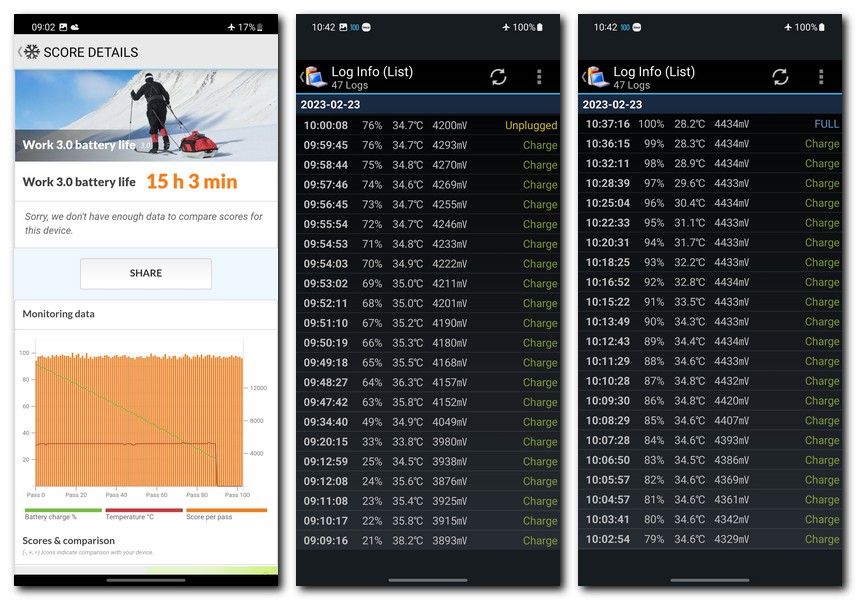
I also ran PCMark’s battery test, which gives a timing score based on the amount of time it takes the battery to reach 20 from 100 percent. In the case of the Galaxy S23, the final result was 15 hours and 3 minutes, which I think is pretty reasonable. for device. For comparison, last year’s Galaxy S22 clocked out in just 10 hours.
The only problem of note is that the S23 is a slouch when it comes to charging speeds. With the Samsung-supplied charger, the device can juice up to 25W, which isn’t even close to what other OEMs offer in this price range. In my tests, the phone charged from 20-75 percent in just under 50 minutes while a full 100 percent took around 30 minutes more.
Decision
Analyzing my time with the Galaxy S23, I can safely say that the battery life of the device is quite good for its compact size. Yes, it is not necessary that the phone is charged at lightning fast speed. However, the average consumer will find their needs well met with the S23’s battery capabilities.


